

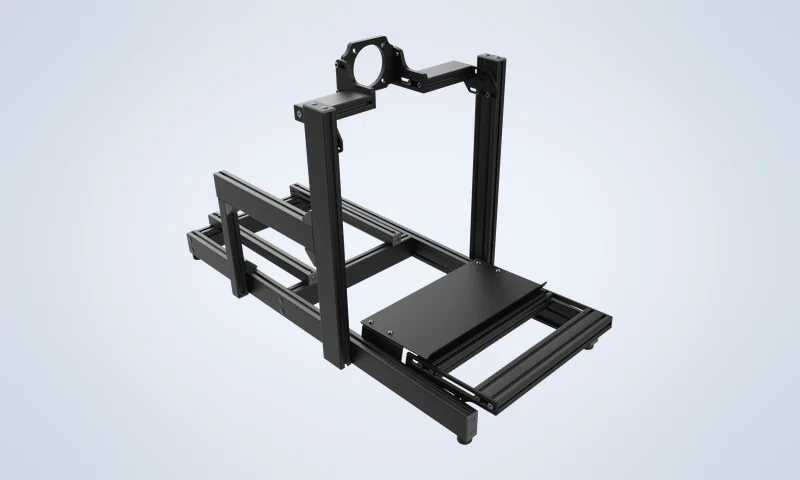
If you are moving up from a desk clamp or a folding tube stand, both the ASR 1 and the ASR 3 ($522.49 net with code SIMRACINGNATION5) give you real T-slot aluminum rigidity. While the ASR 1 keeps costs as low as possible for entry direct drive setups, the ASR 3 is the clear winner for racers who plan to upgrade to 15 Nm or 20 Nm wheelbases.
Frame Stiffness and Profile Dimensions
The ASR 1 uses a 3-inch by 1.5-inch base frame paired with lighter vertical uprights designed for entry-to-mid direct drive wheelbases up to 10–12 Nm. Stepping up to the ASR 3 ($522.49 net) reinforces the steering uprights and mounting brackets so the frame handles up to 20 Nm of sustained torque without flex.
| Feature | ASR 1 Chassis | ASR 3 Chassis |
|---|---|---|
| Base Extrusion Size | 3" x 1.5" Open-Slot Aluminum | 3" x 1.5" Heavy-Wall Aluminum |
| Recommended Wheelbase Torque | Up to 12 Nm Direct Drive | Up to 20 Nm Direct Drive |
| Wheel Deck Options | Standard Steel Wheel Deck | Standard, Front Mount, or Side Mount |
| Shifter Arm Upgrade | Add Supported Shifter Arm ($99.74 net) | Compatible with All ASR Side Mounts |
| Partner Discount | 5% Off (Code SIMRACINGNATION5) | $522.49 Net ($549.99 MSRP) |
Final Verdict: Spend Once or Upgrade Later?
- Choose the ASR 1 if: You run an entry 5 Nm to 10 Nm wheelbase and want the lowest price on a North American aluminum rig.
- Choose the ASR 3 if: You want front-mount wheelbase options and zero-flex braking support for 200 kg load-cell pedals at $522.49 net.
Save 5% on Advanced SimRacing Hardware
Use partner discount code SIMRACINGNATION5 at checkout to save 5% on all cockpits, racing seats, monitor stands, and mounts in the official Advanced SimRacing collection.